
TLDR
Agent banking can make a formal financial account usable closer to where people live and trade. Local businesses act on behalf of regulated providers to handle permitted transactions, potentially reducing travel and waiting time. But agent banking financial inclusion is meaningful only when agents have enough cash and electronic value, transactions work, prices are clear, customers receive proof of payment, and problems can be resolved. An outlet on a map is not the same as dependable access.
The most useful way to assess agent banking is as last-mile service infrastructure. Count agents, but also examine whether customers can complete the transactions they need safely, affordably, and consistently. Access is the first step; service quality and suitable products determine whether that access becomes useful.
What agent banking is—and what it is not
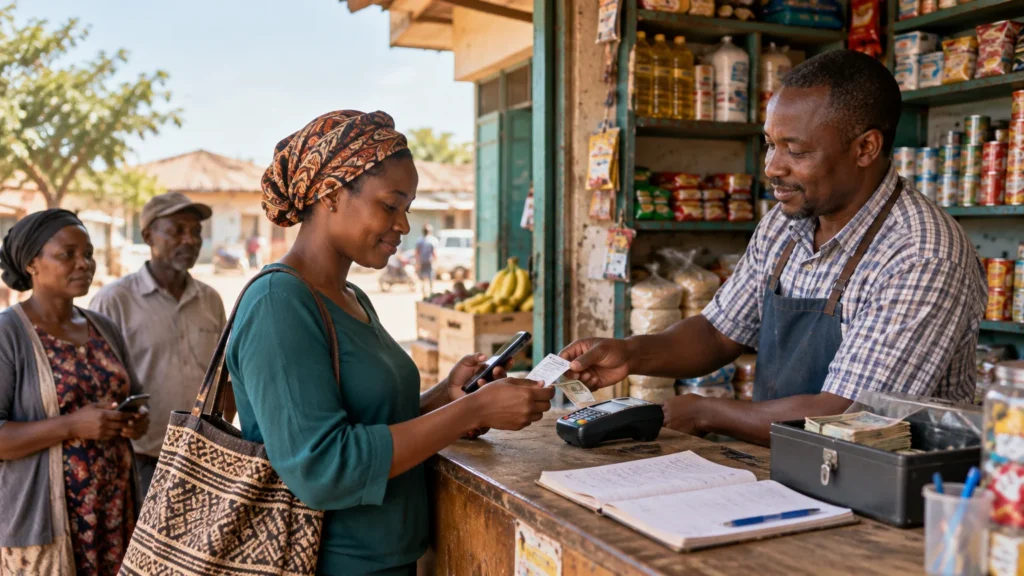
An agent is a person or business authorized to provide specified financial services on behalf of a bank or another regulated provider. A neighborhood shop, pharmacy, post office, fuel station, or dedicated kiosk may serve as the customer-facing location. The provider supplies the financial platform and remains responsible for the relationship within the applicable legal framework; the agent supplies a convenient physical access point.
Services may include deposits, withdrawals, transfers, bill payments, account enrollment, balance inquiries, government-payment collection, or loan-related transactions. The exact list varies by country, provider, agent tier, and authorization. A service available through one network should not be assumed legal or available through another. The World Bank’s overview of agent networks emphasizes that regulation may define permitted activities, authorization arrangements, provider responsibilities, and risk controls.
Agent banking also differs from mobile banking. Mobile banking lets a customer interact with an account through a phone or other digital channel. An agent supplies a physical service point, often helping the customer convert cash into electronic value or electronic value back into cash. The two channels can complement each other.
A bank agent is not always the same as a mobile-money agent. A bank agent acts for a bank or another authorized deposit-taking provider under the relevant framework. A mobile-money or e-money agent may act for a non-bank issuer. Both can provide cash-in and cash-out services, but their permitted products, safeguarding arrangements, and institutional responsibilities may differ. Customers should identify the provider behind the outlet rather than treating every financial-services sign as equivalent.
How agent banking supports financial inclusion
Conventional branches can be expensive to build and operate in places with low population density or modest transaction values. Agent networks use existing local businesses to bring access points closer to rural and low-income communities. They can therefore extend the practical reach of digital financial ecosystems where a distant branch would impose significant travel and time costs.
Proximity matters because an account is not useful merely because it exists. Consider a market trader who receives a digital customer payment but needs cash to buy stock from a supplier. The trader may also need to deposit the day’s proceeds, transfer money to a wholesaler, or make a loan repayment. A functioning nearby agent can connect those cash and digital transactions without requiring a trip to a branch.
Agents may also offer human assistance. A customer unfamiliar with menus, identification procedures, or transaction confirmations may find an assisted service easier than an entirely self-directed digital channel. That assistance can lower practical barriers, although it also creates privacy and fraud risks if an agent asks for a customer’s personal identification number, controls the customer’s phone, or fails to explain a charge.
The inclusion case is therefore strongest when the agent reduces a genuine burden without transferring unreasonable costs or risks to the customer. Moving a microfinance repayment from a distant office to a local agent may save time and transport expense. It is less helpful if the agent regularly lacks liquidity, adds undisclosed fees, or leaves the borrower to resolve failed transactions before a repayment deadline.
What makes an agent network useful—and what failure looks like
| Feature | What useful service looks like | What failure looks like |
|---|---|---|
| Cash and e-float | Enough physical cash for withdrawals and enough electronic value to accept deposits or complete digital transfers | Customers are repeatedly turned away, told to return later, or pressured to change transaction size |
| Pricing and receipts | Fees are displayed or disclosed before confirmation, and customers receive a paper or digital record | Unexpected surcharges, no receipt, or disagreement about whether a transaction occurred |
| Connectivity and systems | Transactions process reliably, and pending or reversed payments have a defined resolution path | Frequent outages, duplicate attempts, uncertain balances, or unexplained delays |
| Training and monitoring | Agents understand permitted services, identity checks, privacy, fraud warning signs, and escalation procedures | Agents improvise rules, mishandle customer data, or cannot explain where complaints should go |
| Rural business viability | Transaction volume, commissions, and support make continued service commercially plausible | The outlet remains nominally listed but opens irregularly, refuses small transactions, or quietly stops serving customers |
| Complaint resolution | Customers can contact the provider through an accessible channel and receive a trackable response | The agent and provider redirect the customer to each other while money remains missing |
Why liquidity determines whether access is real
An agent usually manages two forms of liquidity. Physical cash is needed when customers withdraw. Electronic value, often called e-float, is needed when customers deposit cash or initiate transactions that require digital value. If many customers arrive to withdraw after salaries, benefits, remittances, or harvest payments are credited, the agent can run short of cash. If deposits dominate, the agent can run short of e-float.
This balancing problem is not a minor back-office detail. It determines whether the customer can complete a transaction. Agents may need to rebalance by visiting a bank branch, exchanging value with another agent, using a master agent, or arranging cash delivery. Distance, insecurity, transport expense, forecasting errors, and limited working capital can make that process difficult. World Bank analysis treats liquidity management as a central part of the agent business rather than an issue that disappears as finance becomes more digital.
Liquidity failures can be particularly costly for microenterprises. A household may be able to delay a discretionary withdrawal, but a trader who needs cash to restock before a market day faces a direct operational constraint. Providers should consequently examine when and where failures happen, not merely the network’s total cash position.
Access does not guarantee useful or fair service
Financial inclusion includes more than account ownership. It also concerns whether people use appropriate services for payments, saving, borrowing, and other needs, and whether they can do so safely. The World Bank’s Global Findex is useful for distinguishing ownership from patterns of use, connectivity, and digital safety. It does not, by itself, show that an agent caused higher income, business growth, poverty reduction, or empowerment.
A nearby agent may still be inaccessible to someone who lacks accepted identification, cannot use the required phone or interface, has limited mobility, cannot read the transaction language, or feels unsafe carrying cash to the outlet. Older customers and people with disabilities may need accessible premises or trusted assistance. Customers sharing phones can face added privacy and account-control problems.
Gender can also shape both customer access and agent participation. Women agents may make some women customers more comfortable or improve reach in particular settings, but that is not automatic. Women seeking to operate outlets can face constraints involving working capital, mobility, safety, unpaid care responsibilities, and local social norms. Network design should address those barriers rather than assuming recruitment alone will close gender gaps. For a broader discussion of why access should not be confused with control or agency, see the evidence on microfinance and women’s economic agency.
Agent networks also create consumer-protection, fraud, operational, and anti-money-laundering risks. Controls are necessary, but poorly designed controls can exclude legitimate low-income customers. The practical challenge is to apply proportionate identification, transaction monitoring, and security measures while preserving a workable service for people with small and irregular transactions.
What providers and regulators should require
The regulated provider should remain visibly responsible for services delivered through its agents. Customers need to know which institution stands behind the outlet, which transactions the agent may perform, what each transaction costs, and how to escalate a problem beyond the agent.
A sound operating framework should include:
- Due diligence before appointment, including the prospective agent’s identity, reputation, location, business capacity, and ability to manage cash.
- A visible authorization notice that identifies the provider and the services the outlet may perform.
- Training on transactions, customer privacy, identification requirements, fraud, fee disclosure, recordkeeping, and complaint escalation.
- Routine monitoring for unusual transactions, unauthorized fees, inactivity, liquidity failures, customer complaints, and conduct problems.
- Practical liquidity support, including forecasting tools, rebalancing options, appropriate transaction limits, and emergency escalation.
- Transaction confirmations or receipts that show the amount, fee, time, reference, and provider.
- A complaint channel accessible without returning only to the agent involved in the dispute.
- Clear rules for suspending or terminating an agent while protecting customers with pending cases.
These are general principles, not a substitute for local law. Kenya’s prudential guidance offers one country-specific example: regulated institutions are expected to select credible agents, manage the risks of agency arrangements, and monitor compliance. Requirements elsewhere can differ, so providers and customers should consult the applicable regulator and provider terms.
Implementation details matter as much as written rules. A complaints number displayed on a wall has little value if calls go unanswered, customers cannot obtain a case reference, or frontline staff lack authority to investigate a failed transaction. Similarly, an authorized agent list becomes stale if inactive outlets remain recorded as operational. Earlier field experience with digital-finance agent entry also shows why network expansion must be understood as an operating model, not simply a recruitment exercise; see this agent entry model for digital financial services.
How to measure agent banking financial inclusion
Agent counts and accounts opened are easy to report, but they reveal little about whether the service works. A network can appear extensive while many outlets are inactive, poorly supplied, or clustered in already well-served areas.
A more useful measurement dashboard should ask:
- What share of listed agents are active, and how regularly are they open?
- How far and how long do customers travel compared with the previous option?
- What proportion of attempted transactions succeeds on the first try?
- How often do agents lack cash or e-float, and at what times and locations?
- Are official fees disclosed before confirmation, and are agents adding unauthorized charges?
- How many customers continue using the service after enrollment?
- Which services are used—not just offered—and by which customer groups?
- How many complaints concern failed, delayed, mistaken, or fraudulent transactions?
- How quickly are complaints acknowledged and resolved, and is lost money restored when appropriate?
- Are rural and low-volume outlets commercially sustainable without weakening service quality?
- Do outcomes differ by gender, disability, age, location, phone access, or other relevant characteristics?
These indicators separate physical presence from dependable service. They also help providers identify whether a weak outlet needs more working capital, better rebalancing, technical support, retraining, stronger supervision, or removal from the network.
The practical test: can the customer complete the task?
Agent banking can extend financial services beyond branches because it combines digital account infrastructure with a local point for cash handling and assistance. That combination is especially relevant in economies where cash remains central to daily trade. Yet proximity alone does not establish inclusion, and transaction access alone does not prove improvements in income, enterprise growth, or household welfare.
The practical test is straightforward: can a customer complete the needed transaction at a predictable cost, receive reliable confirmation, protect personal information, and obtain a remedy when something goes wrong? Providers and regulators should assess agent banking as dependable local infrastructure—not merely as a map of outlets or a count of newly opened accounts.
References
- Agent Networks | Digital Finance Inclusion
- Permitted Services | Digital Finance Inclusion
- Developing Rural Agent Networks: Emerging Guidance for Funders | CGAP Research & Publications
- Agent Networks at the Last Mile: Implications for Policy Makers | CGAP Research & Publications
- World Bank Document
- World Bank Document
- Report
- Women Agents for Financial Inclusion: Exploring the Benefits, Constraints, and Potential Solutions | CGAP Research & Publications
- PGs