
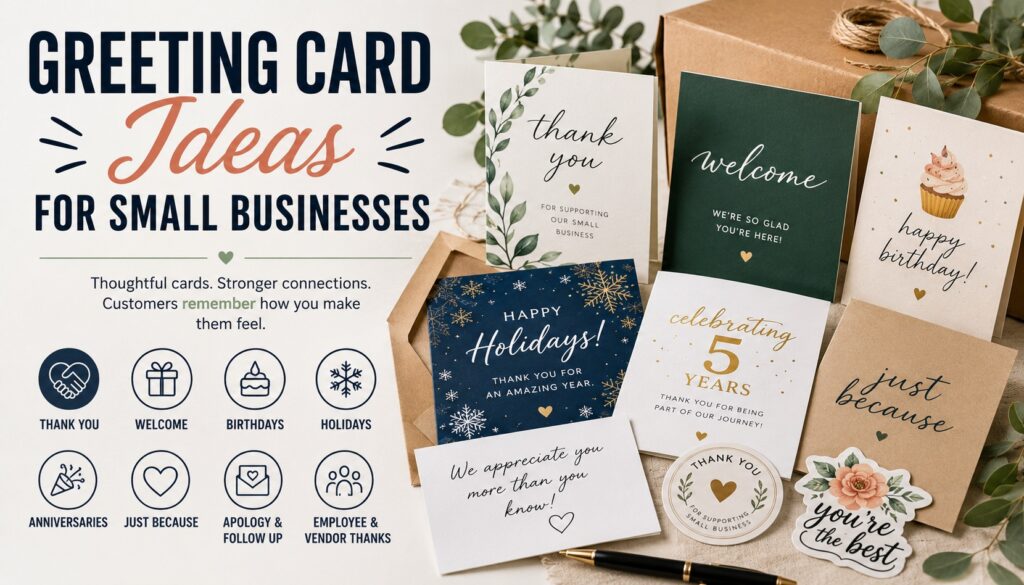
TLDR
Greeting cards give small businesses a simple way to thank customers, welcome new clients, celebrate milestones, and stay connected without sending another sales email.
The most useful small-business greeting cards include:
- Thank-you cards
- First-order welcome cards
- Customer birthday cards
- Holiday cards
- Business anniversary cards
- Reorder reminders
- Apology and service-recovery cards
- Employee and vendor appreciation cards
Keep the message short and personal. Add a handwritten line whenever possible, and use branded stickers to finish envelopes or include a small extra the customer can keep.
A customer opens a package and finds a small card on top. It does not include a complicated offer or a long company history. It simply thanks them by name and mentions the product they ordered.
That card may take less than a minute to write. But it feels noticeably different from an automated order confirmation.
Greeting cards give small businesses a physical way to acknowledge the people who buy from them, refer new customers, support a launch, or help the company operate. They can be mailed on their own, added to an order, handed to a customer after an appointment, or included with a local delivery.
And they do not need to be elaborate. A clear design, a sincere sentence, and one personal detail are usually enough.
Why Greeting Cards Work for Small Businesses
Most business communication is temporary.
Emails disappear into crowded inboxes. Social posts move down the feed. Text messages are read and forgotten. A physical card can sit on a desk, refrigerator, counter, or bulletin board long after it arrives.
That does not mean a greeting card should be treated as a guaranteed marketing tactic. Its value comes from the relationship it supports. A generic card sent to everyone may feel like advertising. A relevant card with a specific message can feel like genuine recognition.
Hallmark Business recommends making professional thank-you messages brief, sincere, and specific about what the recipient did or why the business is grateful. Personalizing the message with the recipient’s name and a real detail makes the appreciation feel less automatic.
The best small-business greeting cards usually do one of three things:
- Thank someone.
- Recognize a meaningful occasion.
- Help maintain a relationship between purchases.
Start with that purpose before choosing the design.
1. Customer Thank-You Cards
A thank-you card is the most versatile option for a small business.
It can be included with an order, handed to a customer after a service, or mailed separately after a large project. The message should refer to something specific whenever possible.
Instead of:
Thank you for your business.
Try:
Thank you for trusting us with your storefront signs. We enjoyed working with you and hope the new location has a strong opening.
Or:
Thank you for your order, Maria. We hope the new labels are a great fit for your spring collection.
A specific message shows that the card was written for the recipient rather than pulled from a stack without much thought.
Thank-you cards work especially well after:
- A customer’s first purchase
- A large or custom order
- A completed home service
- A long-term client renewal
- A referral
- A positive review
- A customer’s help resolving a problem
- A successful event or collaboration
Do not use every thank-you card as an excuse to sell something. Sometimes the best next step is simply leaving the customer with a positive impression.
2. First-Order Welcome Cards
A first purchase is a good time to explain what customers can expect from the business.
A welcome card can thank the customer while also answering one useful question. It might include product-care instructions, contact information, reorder details, or a quick explanation of the company’s process.
For example:
Welcome to North Street Coffee. Thank you for trying our house blend. For the best flavor, store the bag sealed and away from direct heat or sunlight.
Or:
Thanks for choosing us for your first order. If anything arrives differently than expected, reply to your order email and our team will help.
The card should make the customer feel supported, not enrolled in a loyalty campaign they did not ask to join.
A small logo sticker can make the welcome package feel more complete. CustomStickers.com offers custom business stickers that can be included as package extras, used as envelope seals, or designed around a business logo or mascot.
3. Customer Birthday Cards
Birthday cards can work well for businesses that have an ongoing relationship with customers.
Examples include:
- Salons and barbershops
- Fitness studios
- Dental and medical offices
- Financial professionals
- Real estate agents
- Pet groomers
- Tutors
- Membership businesses
- Restaurants with loyalty programs
A birthday message does not need to include a discount. A simple card may feel more personal when it is not immediately tied to a purchase.
Example:
Happy birthday, Taylor. We hope the year ahead brings plenty of good things. Thank you for being part of our community.
A modest birthday offer can still make sense when it fits the business:
Bring this card in during your birthday month for a complimentary dessert.
Make the terms clear. Avoid offers that expire before the card is likely to arrive or require a complicated list of conditions.
Only send birthday cards when the customer has willingly provided that information and when using it fits the relationship. A birthday card from a neighborhood salon may feel thoughtful. A birthday card from a business the customer used once seven years ago may feel less natural.
4. Holiday Greeting Cards
Holiday cards are familiar, but small businesses do not need to send the same generic December message as everyone else.
Choose a card that reflects the customers, region, and personality of the business. Options include:
- General season’s greetings
- New Year cards
- Thanksgiving appreciation cards
- Christmas cards
- Local winter-themed cards
- Industry-specific holiday humor
- Photo cards featuring the team
- Illustrated cards featuring a mascot or storefront
A general holiday message works for a broad customer list:
Thank you for supporting our small business this year. We hope you have a peaceful holiday season and a happy New Year.
A more personal version works for a smaller group of clients:
We are grateful for the projects we completed together this year. Thank you for trusting our team, and we look forward to seeing what you create next.
Hallmark Business offers customer holiday cards built around gratitude as well as more general seasonal messages. It also recommends considering the printed inside message and adding a personal note rather than relying only on the cover design.
Send holiday cards early enough that they do not arrive in the middle of a last-minute promotional rush. Or skip the crowded season and mail a New Year thank-you card in January.
5. Business Anniversary Cards
A company anniversary is a chance to thank the customers who helped the business reach the milestone.
The card can celebrate:
- One year in business
- Five, ten, or twenty years
- The anniversary of a store opening
- A major order milestone
- A completed renovation
- A new location
- A founder’s retirement
- A significant product anniversary
Keep the emphasis on the customer rather than turning the card into a company victory lap.
For example:
We opened our doors five years ago this month. Thank you for every visit, referral, review, and kind word that helped us get here.
You can include a small anniversary sticker with the card. A five-year seal, limited-edition logo, or illustrated business milestone gives customers something separate to keep.
6. Customer Milestone Cards
The occasion does not always need to belong to the business.
Greeting cards can recognize customer milestones such as:
- A new home
- A business opening
- A graduation
- A wedding
- A new baby
- A retirement
- A promotion
- The completion of a major project
These cards work best when the business naturally knows about the milestone.
A real estate agent may send a home anniversary card. A wedding photographer may send a first-anniversary note. A business consultant may congratulate a client on opening a second location.
Example:
Congratulations on your first year at the new location. It has been great watching the business grow, and we are glad we could play a small part.
Avoid making the message about what the recipient should buy next. Recognition is the purpose.
7. “Just Because” Customer Appreciation Cards
You do not always need a holiday or milestone.
A card sent at an unexpected time may receive more attention because it is not competing with dozens of other seasonal messages. Hallmark Business includes “just because” alongside appreciation, birthday, welcome, apology, and holiday cards for customers and clients.
Good times to send one include:
- After a customer has placed several orders
- At the end of a busy season
- After someone refers multiple customers
- When a client has been with the company for one year
- During a normally slow month
- After a local customer supports a community event
Example:
There is no promotion attached to this card. We simply wanted to thank you for continuing to choose our team.
That message is unusual enough to be memorable because it asks for nothing.
8. Reorder Reminder Cards
Some products and services need to be replaced, renewed, maintained, or scheduled regularly.
A greeting-card format can make a reminder feel more considered than a plain sales postcard. It works for:
- Furnace and air-conditioning maintenance
- Dental appointments
- Pet grooming
- Vehicle service
- Product refills
- Seasonal landscaping
- Pest control
- Filter replacement
- Subscription renewals
- Annual inspections
Keep the card useful:
It has been about six months since your last service. This is a friendly reminder to check your filter and schedule maintenance before the summer rush.
Include one clear booking method. A phone number, short URL, or QR code is enough.
Do not disguise a hard sales pitch as a personal greeting. The recipient should understand why the business is contacting them.
9. Apology and Service-Recovery Cards
Most businesses eventually make a mistake.
An order may arrive late. An item may be damaged. A scheduling problem may inconvenience a customer. A written apology can show that the company takes the issue seriously, especially when it follows real corrective action.
The card should include:
- A direct apology
- A brief acknowledgment of what happened
- What the business did to correct it
- A clear contact method
- Any appropriate replacement, refund, or credit
Example:
We are sorry your order arrived damaged. We have already sent a replacement and reviewed the packaging with our shipping team. Thank you for giving us the opportunity to fix it.
Do not use vague wording such as “We are sorry you feel that way.” And do not make the customer read a long explanation of why the mistake was technically someone else’s fault.
The card supports the recovery. It does not replace it.
10. Referral Thank-You Cards
A referred customer can be valuable, but the person who made the introduction is often forgotten once the new order arrives.
Send a short card after a successful referral:
Thank you for recommending us to Jordan. Referrals mean a great deal to a small business, and we appreciate your confidence in our team.
You may include a reward when the referral program promises one. But even without a formal incentive, the acknowledgment matters.
Referral cards can also include two detachable or separate offer cards: one for the current customer and one to share with a friend. Keep the process simple enough that employees and customers can explain it in one sentence.
11. Employee Appreciation Cards
Greeting cards are not limited to customers.
Small businesses can use them to recognize employees for:
- Work anniversaries
- Birthdays
- Promotions
- Strong customer feedback
- Project completion
- Safety milestones
- Seasonal effort
- Personal achievements
A useful employee card names the contribution:
Thank you for staying late to help finish the Oak Street order. Your attention to detail kept the project on schedule.
That is stronger than a printed card with only “Great job.”
Have the owner, manager, or team members sign it. The card should feel like recognition from actual people, not a substitute for compensation or management support.
12. Vendor and Partner Thank-You Cards
Suppliers, freelancers, delivery partners, event organizers, and neighboring businesses all contribute to a small company’s work.
A short card can strengthen those relationships:
Thank you for helping us meet a difficult deadline last week. Your quick response made a real difference.
Send vendor cards after an especially demanding project, at the end of the year, or when a partner goes beyond the normal agreement.
This is also a good format for thanking another local business after a shared promotion, pop-up, fundraiser, or community event.
13. Cards for Local Events
Local businesses can create greeting cards tied to the places and events their customers recognize.
Ideas include:
- A town festival illustration
- A local landmark
- A neighborhood map
- A community sports theme
- A farmers market design
- A seasonal regional scene
- A drawing of the storefront
- Artwork from a local artist
The card can be given to customers, sold as merchandise, or mailed after the event.
Avoid making every local card look like an advertisement. Place the business name or logo discreetly on the back and let the artwork do most of the work. Customers are more likely to keep a card that looks good on its own.
14. Blank Branded Note Cards
Not every card needs to be designed for a single occasion.
A set of blank branded note cards gives employees a flexible option for thank-yous, congratulations, apologies, welcome messages, and personal follow-ups.
Keep the front simple:
- A small logo
- A custom illustration
- A subtle pattern
- A short brand phrase
- A photograph of the local area
Leave the inside blank. Handwriting even two or three sentences makes the card more adaptable and personal.
Store the cards with envelopes, pens, postage, and a list of situations when employees should use them. A card program is much more likely to continue when the supplies are easy to find.
Use Stickers to Finish the Card
Stickers can support a greeting card without replacing the message.
Use them as:
- Envelope seals
- Branded package extras
- Decorative accents
- Address-label details
- Limited-edition holiday seals
- Anniversary markers
- Small gifts inside the card
- QR code links to instructions or offers
CustomStickers.com offers custom vinyl stickers in custom shapes and quantities. A small logo, mascot, seasonal illustration, or local design can turn the card into a more complete branded piece.
For cards included with product orders, label and packaging stickers can also coordinate the envelope, tissue paper, box, or product container.
Do not cover the card in branding. One strong sticker usually works better than several competing logos.
How to Write a Better Business Greeting Card
A useful message can follow a simple four-part structure:
- Address the recipient by name.
- State the occasion or reason for writing.
- Add one specific detail.
- Close warmly without forcing a sale.
For example:
Hi Morgan,
Thank you for ordering your event labels from us again this year. We especially enjoyed the new summer design. We appreciate your continued support and hope the event goes well.
Ryan and the CustomStickers.com team
Keep the message short enough that handwriting it does not become a burden.
Avoid Generic Language
Phrases such as these are not wrong, but they need something more:
- We value your business.
- Thank you for being a customer.
- Warmest wishes.
- We appreciate your support.
Add a detail that proves the business knows who is receiving the card.
Match the Brand’s Voice
A law office, toy store, coffee shop, and auto-repair business should not sound identical.
A professional service may use:
Thank you for the opportunity to work together this year.
A casual retail brand may use:
Thanks for keeping our little shop busy. We are glad you found us.
The message should sound like the same business the customer encounters online and in person.
Sign the Card
A printed signature is efficient for large mailing lists. A handwritten signature or short note is better for smaller groups and important relationships.
You do not need to write every word by hand. A printed message with one handwritten sentence still feels more personal than an untouched card.
Choosing the Right Card Format
Different situations call for different formats.
| Format | Best Use |
|---|---|
| Folded greeting card | Personal notes, holidays, apologies and important milestones |
| Flat note card | Package inserts and brief thank-yous |
| Postcard | Event announcements and broad local mailings |
| Small enclosure card | Product care, reorder instructions and order appreciation |
| Photo card | Team updates, holidays and business anniversaries |
| Blank branded card | Flexible year-round communication |
Postcards are easier and less expensive to prepare, but the message is visible during delivery. Use an envelope when the content is personal.
USPS also offers Every Door Direct Mail for broad local campaigns involving postcards, menus, flyers, and similar pieces delivered along selected postal routes. That can be useful for a neighborhood promotion, but it is a different tool from a personal greeting-card program.
Common Greeting Card Mistakes
Avoid these common problems:
- Sending a card only when asking for another purchase
- Using a message that could apply to anyone
- Adding several competing offers
- Waiting too long after the occasion
- Misspelling the recipient’s name
- Using customer information without permission
- Including an offer with unclear restrictions
- Printing text too small to read
- Using a tone that does not fit the business
- Treating cards as a replacement for fixing a problem
- Sending the same holiday card to every customer regardless of context
And check every envelope before mailing. A thoughtful card addressed to the wrong customer creates a very different impression.
A Simple Small-Business Card Plan
You do not need to launch twelve card campaigns at once.
Start with three:
- Thank-you cards for major orders, referrals, or completed projects.
- Welcome cards for first-time customers.
- Seasonal cards for the customers and partners who had the strongest relationship with the business that year.
Keep a small supply of blank branded cards for situations that do not fit the plan.
Track cards in the customer record or order notes so the same person does not receive duplicates. Set aside one time each week for writing and mailing them. Ten thoughtful cards sent consistently are more useful than 500 generic cards ordered and left in a cabinet.
Make the Card About the Recipient
A small-business greeting card works best when it feels like a message first and marketing second.
Choose a real reason to write. Use the recipient’s name. Add one detail that shows why the message was sent. Then stop before the card turns into a brochure.
The design can support the experience, and a branded sticker can add a useful finishing touch. But the sentence inside is what gives the card its value.