
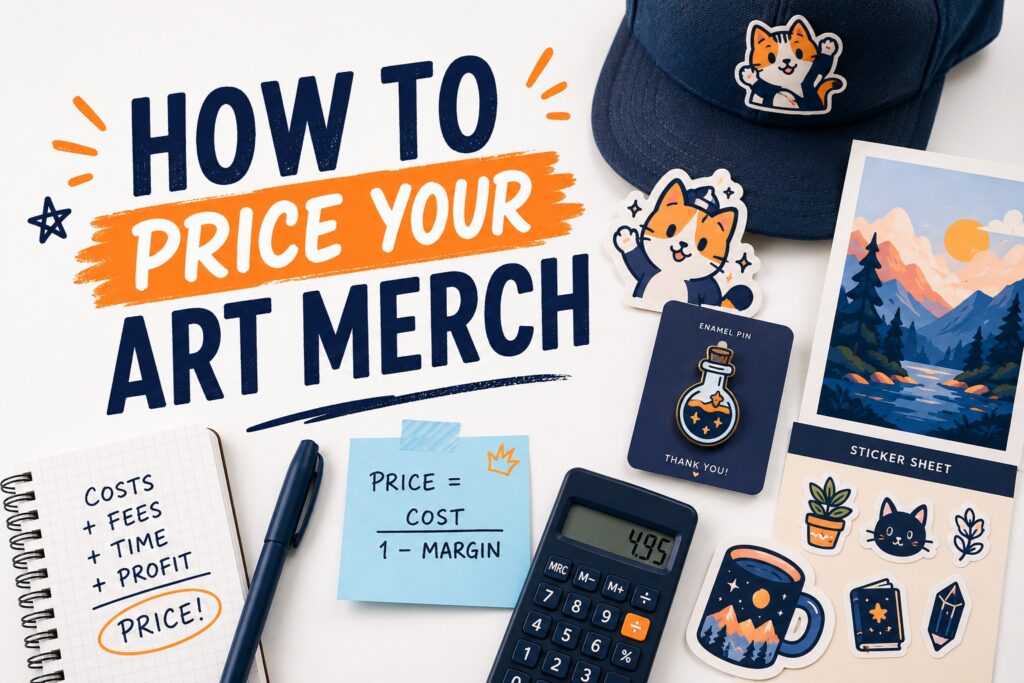
TLDR
- Start with the real cost of each item, including production, packaging, fees, shipping materials, and your time.
- Use a margin formula instead of copying another artist’s prices.
- Price simple items like stickers differently than higher-cost merch like apparel, pins, or large prints.
- Bundles can raise order value without making every single item feel expensive.
- Good pricing should feel fair to the customer and still leave room for profit, reorders, and growth.
A lot of artists price merch by asking one quiet question: “Would I pay this much?”
That feels natural, but it is not enough. You are not just pricing a sticker, print, pin, tote bag, or shirt. You are pricing the artwork, the production cost, the packaging, the platform fees, the event table, the test runs, the unsold inventory, and the time it took to make the whole thing happen.
That does not mean your art merch needs to be expensive. It means your pricing needs to be honest. When you know your numbers, you can sell with more confidence, offer better bundles, and avoid the slow burn of realizing that your “popular” product barely makes money.
Start With Your Real Unit Cost
The first step is finding your unit cost. This is the amount it costs you to produce one sellable item.
For art merch, that might include:
- The item itself, such as a sticker, print, pin, shirt, charm, or notebook
- Packaging, like backing cards, sleeves, envelopes, boxes, tissue, or mailers
- Shipping supplies
- Platform fees from Etsy, Shopify, Square, PayPal, or other checkout systems
- Payment processing fees
- Event costs, if you sell at markets or conventions
- Damaged items, test prints, samples, and extras
- Your time for packing, labeling, ordering, photographing, and listing the product
This is where many artists underprice. They remember the production cost but forget the rest.
A sticker that costs 70 cents to print may not really cost 70 cents to sell. Add a backing card, a protective sleeve, a mailer, transaction fees, and a few minutes of packing time, and the true cost is higher.
That does not mean you need to panic over every penny. But you should know the rough number before you set a retail price.
Use Margin, Not Just Markup
Markup and margin are not the same thing.
Markup is how much you add on top of your cost. Margin is how much of the final selling price you keep after the product cost.
Here is the simple margin formula:
Retail Price = Total Cost ÷ (1 – Desired Margin)
So if an item costs you $1.20 total and you want a 60% margin:
$1.20 ÷ 0.40 = $3.00
That means you would need to sell the item for $3 to keep 60% of the selling price after the product cost.
This is useful because art merch often has small items with small dollar profits. A $1 profit may sound fine until you realize it does not leave much room for fees, discounts, damaged inventory, or wholesale orders.
A healthy price gives you space to keep making art without every sale feeling like a favor.
Price Stickers as Small Merch, Not Throwaway Extras
Stickers are one of the easiest art merch products to start with. They are light, affordable to produce, easy to ship, and simple for fans to buy on impulse. But they still need to be priced like real products.
For many artists, stickers work well in the $3 to $5 range depending on size, material, finish, and design detail. Smaller simple stickers may sit lower. Larger die cut designs, specialty finishes, or detailed illustrations can usually sit higher.
A good sticker pricing setup might look like this:
| Sticker Type | Example Retail Approach |
|---|---|
| Small basic sticker | $2 to $3 |
| Standard die cut sticker | $3 to $5 |
| Large detailed sticker | $5 to $7 |
| Specialty finish sticker | $5+ |
| Sticker bundle | 3 for $10, 5 for $15, or themed pack pricing |
The exact numbers depend on your audience, art style, cost, and where you sell. Convention buyers, online shoppers, wholesale buyers, and local market customers may all respond differently.
If stickers are a core part of your art merch, start with quality. A cheap sticker that fades, scratches, or peels too fast can hurt the value of your work. For durable sticker merch, artists can turn their designs into custom stickers for art drops and build small products that feel polished without requiring a huge upfront product line.
Use Bundles to Make Pricing Feel Easier
Bundles are one of the cleanest ways to price art merch.
A single sticker for $4 may feel fine. But three stickers for $10 often feels better to the buyer and better for your average order value. The customer gets a small deal, and you move more inventory per sale.
The same idea works for prints, buttons, bookmarks, mini prints, postcards, and sticker sheets.
Examples:
| Product | Single Price | Bundle Idea |
|---|---|---|
| Sticker | $4 | 3 for $10 |
| Mini print | $8 | 2 for $14 |
| Postcard | $3 | 4 for $10 |
| Button | $3 | 2 for $5 |
| Sticker sheet | $8 | 2 for $14 |
Bundles work especially well when the designs belong together. A matching set feels more intentional than a random discount.
For example, a fantasy artist could sell a dragon sticker, sword sticker, potion sticker, and castle sticker as a themed set. A food illustrator could bundle ramen, boba, sushi, and dumpling stickers. A tattoo artist could create flash-style sheets instead of only selling individual designs.
If you have several small designs, custom sticker sheets can make the bundle feel more finished. They also give customers a reason to buy the full set instead of choosing one design and walking away.
Price Prints Differently Than Stickers
Prints are not priced like stickers. They have different costs, different customer expectations, and different display value.
A print is usually bought as art for a wall, desk, shelf, frame, or gift. That gives it more perceived value than a small impulse item. But prints also require careful packaging, especially if you ship them.
When pricing prints, include:
- Print cost
- Test prints and color correction
- Backing board
- Clear sleeve
- Rigid mailer or tube
- Label and shipping supplies
- Damaged or bent replacements
- Artist signature, numbering, or edition work
- Selling platform fees
Open edition prints can usually be priced lower than limited edition prints. Signed and numbered prints can be priced higher, but only if the presentation supports it. A limited edition should feel intentional, not just like a reason to charge more.
A basic 5″ x 7″ mini print may work as an affordable add-on. An 11″ x 14″ print should usually carry a stronger price because it has more display presence and higher shipping demands.
Do not price prints only by paper size. Price them by cost, quality, demand, and how the customer will use them.
Specialty Merch Should Carry Specialty Pricing
Not all art merch should have the same margin.
Some items are easy to restock and low-risk. Others require higher minimum orders, longer lead times, more storage, or more cash upfront.
Specialty merch includes:
- Enamel pins
- Acrylic charms
- Keychains
- Apparel
- Tote bags
- Holographic stickers
- Foil prints
- Embroidered patches
- Notebooks
- Washi tape
These items often need more careful pricing because mistakes cost more. If you order 100 enamel pins and the design does not sell, that money is tied up. If you order shirts in five sizes, you may sell out of medium and sit on extra smalls for months.
For specialty items, build in more margin. You are not just covering the item. You are covering the risk.
For lower-risk premium products, specialty stickers can be a good middle ground. A shiny finish can make a design feel collectible without the same complexity as apparel sizing or pin manufacturing. If you want a premium version of a popular design, holographic sticker merch is a practical way to test that demand.
Do Not Copy Competitor Pricing Blindly
Competitor research is useful. Copying is not.
Another artist’s $4 sticker might have a totally different cost structure. Maybe they ordered 5,000 units. Maybe they print at home. Maybe they lose money on stickers but make it up on commissions. Maybe they have a larger audience and can sell faster. Maybe they are underpricing and do not realize it yet.
Use competitor pricing to understand the market range. Then come back to your own numbers.
Look at:
- Product size
- Material quality
- Finish
- Packaging
- Audience
- Brand strength
- Selling channel
- Shipping model
- Bundle offers
- Whether the product is handmade, manufactured, signed, or limited
The goal is not to be the cheapest. The goal is to be priced in a way that makes sense for your product and your buyers.
Think About Where You Sell
The right price can change by channel.
At an artist alley table, people can see the product in person. They may buy several small items at once. Bundle pricing and clear signage matter a lot.
On Etsy, customers compare listings quickly. Photos, shipping cost, reviews, and search visibility all affect what feels reasonable.
On your own Shopify store, you have more control over branding, bundles, email marketing, and product presentation. But you also have to drive the traffic yourself.
At wholesale, the math changes again. If a shop buys your merch to resell, they need room for their own markup. A product that sells for $10 retail may need a wholesale price around $5 or $6, depending on the category and arrangement. That means your cost has to be low enough for wholesale to make sense.
Not every item needs to be wholesale-friendly. Some products work better direct-to-customer.
Build a Simple Pricing Ladder
A pricing ladder gives customers easy entry points.
For art merch, a simple ladder might look like this:
| Tier | Product Examples | Purpose |
|---|---|---|
| Low price | Stickers, bookmarks, postcards, buttons | Easy impulse buys |
| Mid price | Sticker sheets, mini prints, charms, small bundles | Better order value |
| Higher price | Large prints, apparel, pins, signed editions | Stronger collector items |
| Premium price | Originals, limited editions, framed work | Serious buyers and collectors |
This helps you avoid putting too much pressure on one product.
A customer who cannot buy a $40 print may still buy a $4 sticker. A customer who loves your work may start with a sticker, then come back for a print later. That small first purchase matters.
This is also where die cut art stickers are useful. They turn a single illustration, logo, character, or phrase into an accessible product without asking customers to commit to a higher-priced piece right away.
Account for Discounts Before You Offer Them
Discounts are easy to offer and hard to recover from.
Before you run a sale, check the math. If you sell a $10 product at 20% off, the customer pays $8. But your costs did not drop. Your packaging, fees, and time are still there.
Instead of discounting everything, consider:
- Bundle pricing
- Free small sticker after a certain order amount
- Limited-time product sets
- Slight discounts on older designs
- Buy more, save more pricing
- Event-only bundles
A discount should have a job. It should move older inventory, raise average order value, reward loyal customers, or help launch a new product. It should not be a reflex.
Test Prices Without Overcomplicating It
You do not need a giant spreadsheet to test your merch pricing. Start with a few clear numbers and watch what happens.
Track:
- Which products sell fastest
- Which products get compliments but few purchases
- Which bundles people choose
- Which items sell better in person than online
- Which designs get repeat orders
- Which products have annoying packaging or shipping issues
- Which items produce the most profit, not just the most sales
Sometimes the product everyone praises is not the product that pays the bills. That is fine. Keep the fun pieces if they support your brand, but know which items carry the shop.
After a few shows or a few months online, adjust. Raise prices on items that sell quickly and have strong demand. Retire products that take too much effort for too little return. Turn popular designs into new formats.
Pricing is not a one-time decision. It is part of running the merch line.
Common Art Merch Pricing Mistakes
The biggest mistake is treating profit like something extra. Profit is what lets you reorder, improve packaging, buy better supplies, test new products, pay yourself, and keep going.
Other common mistakes include:
- Forgetting transaction fees
- Forgetting packaging costs
- Pricing based on guilt instead of math
- Making every product too cheap
- Offering free shipping without building it into the price
- Ordering too many untested designs
- Creating too many product types at once
- Setting wholesale prices after the retail price is already too low
- Not charging more for specialty finishes or limited editions
A softer mistake is assuming fans will know the value of the product without help. Presentation matters. Good photos, clear product descriptions, clean packaging, and consistent branding make pricing easier to accept.
A Practical Pricing Example
Say you are pricing a standard art sticker.
Your rough costs might look like this:
| Cost Item | Example Cost |
|---|---|
| Sticker production | $0.85 |
| Backing card or sleeve | $0.20 |
| Mailer share or packing material | $0.25 |
| Transaction/platform fee estimate | $0.45 |
| Total estimated cost | $1.75 |
If you want around a 60% gross margin, the formula would be:
$1.75 ÷ 0.40 = $4.38
You might price that sticker at $4.50 or $5. Or you might sell it as part of a bundle, such as 3 for $12.
That does not mean every sticker should cost $5. It means the math gives you a starting point. From there, you can adjust based on design size, finish, audience, and sales channel.
The same logic applies to prints, shirts, pins, charms, and every other merch item.
Final Thoughts
Pricing art merch gets easier when you stop guessing and start using a system.
Start with your real costs. Decide on a margin that leaves room for fees, packaging, reorders, and your time. Use bundles to make buying feel easy. Price specialty items with more care because they carry more risk. And do not be afraid to raise prices when the numbers say you should.
Good pricing is not about charging as much as possible. It is about building a merch setup that customers understand and artists can actually sustain.